
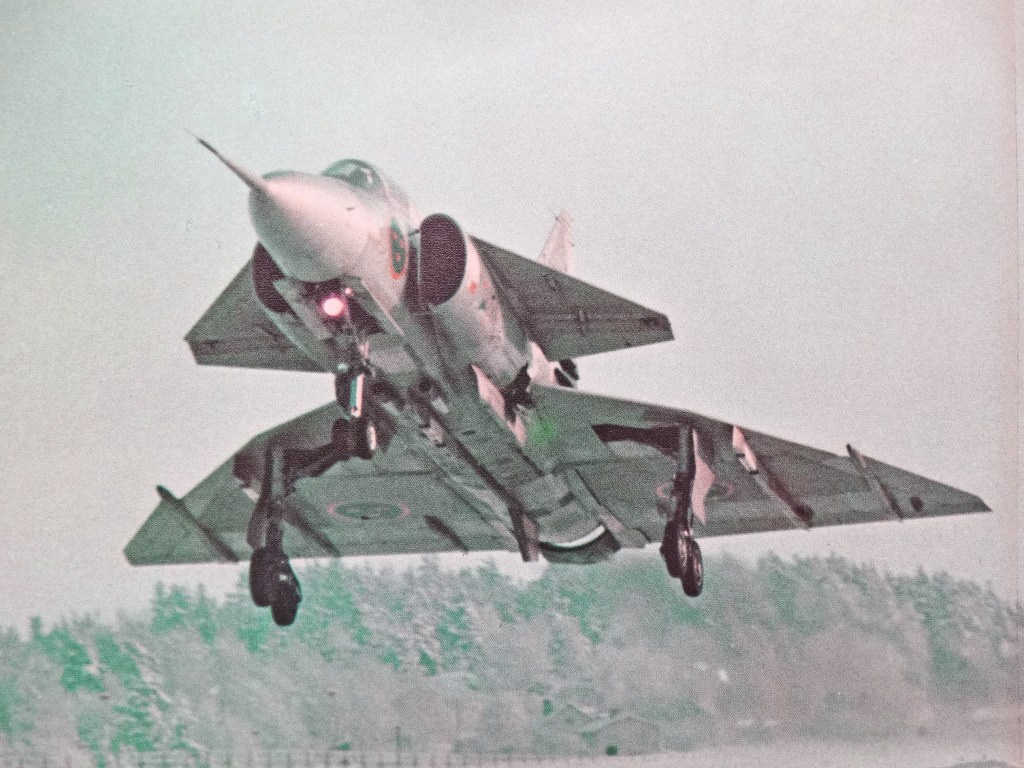
There have been a few questions about this versatile airplane since my last blog a couple of weeks ago. So, I thought I would get into a bit of the nuts and bolts to explain why the AJ37 Viggen was considered the most advanced fighter in the world when it was introduced in 1971.
I do not have extensive experience in European fighters, but I’ve flown a few, and what I’ve noticed is that European fighters were designed with more built-in aerodynamic stability. They flew more like Cadillac’s compared to U.S. aircraft. Stability augmentation ON or OFF; all about the same. Stability and maneuverability are mutually exclusive, they told us in test pilot school. The solution to having an ultra-maneuverable fighter, then, was to “design out” this problem through the use of digitally controlled internal aerodynamics. Some modern fighters are barely controllable with stabs OFF. The Viggen was comfortable to fly with stabs OFF, yet delivered more than adequate pitch and roll performance.
Someone asked why I did my first take-off in max A/B while holding the control stick all the way aft in my lap. Good question. We did this test to determine nosewheel lift-off speed under maximum load – that would give us an indication of longitudinal control power. You’ll notice that the nose popped up pretty smartly after a very short take-off run. (You will have to pull up my first blog on testing the Viggen to catch this).
One other little thing to cope with if you’re off somewhere flying foreign aircraft – you’re likely to encounter he metric system. Altitude in meters. Airspeed in “furlongs per fortnight” – OK, kilometers per hour! This can cause some mental gymnastics, particularly in the landing pattern.
The Viggen was a very fast airplane at low altitude – and it gave a smooth ride. Thanks are due to the low aspect ratio delta-planform wing and (for you aero types) a low l-alpha term. Speaking of the wing, the harmony designed into the main wing/forewing concept was just beautiful to behold. Besides generating a vortex stream which greatly enhanced main wing performance (think of the LEX in an F/A-18), the forewing did a good job of compensating for the gobs of drag associated with a delta wing.
The Viggen had a low wing loading (two wings!), excellent thrust-to-weight ratio at combat weight and excellent handling throughout its envelope. The airplane was a bit sluggish in MIL power, but the RM8’s huge afterburner really changed the game. A 72% kick in the backside gave the Viggen brute power comparable to an F-4, at least. Dogfighter? I thought the Viggen could whip anything on the planet.
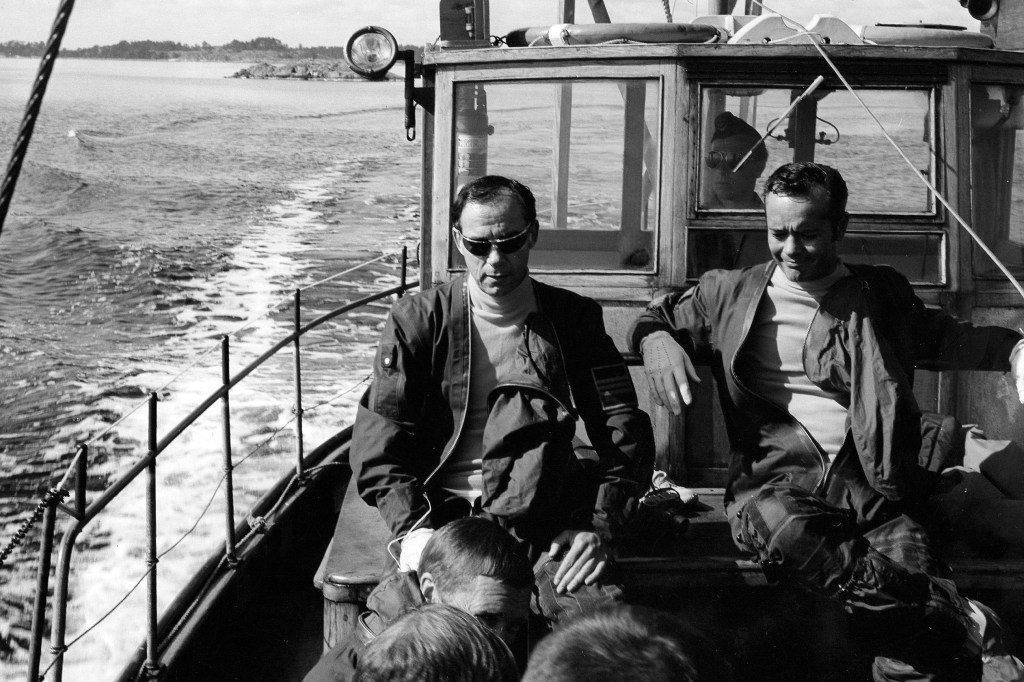
I could go on and on, and actually I do – in my book. For now, take a look at a couple of videos. The first is a touch-and-go, which gives you a pretty good look one of the test airplanes. The second video is of me exiting the cockpit and doing a little walk-around. Note the tandem main landing gear. Note that I had hair then. There is also a snapshot of me and my team mate, George White.
 Above Average
Thats a great photo. George is my grandfather on my mothers side.
LikeLike
The picture you posted with another gentleman sitting on a ship was my father. I would love to get in touch with you to hear any stories you have about him. He passed back in 2007.
LikeLike
This is fascinating. Thanks for the post… It was especially surprising if you scroll down to the bottom picture you’ve used in black and white the man sitting to the right is my father George William White Junior. He passed away 11 1107 and it’s always great to see his face pop up.
LikeLike
Hello Heather, Kim, Jennifer and Len. So glad to hear from you and I’m a bit astonished as well! First, I did not know that George had passed away … may he rest in peace. I did not know George before we were paired to do the Viggen tests, and I lost track of him after the tests were wrapped up. We were from different Navy pipelines — he flew fighters and I flew primarily attack aircraft. Since the Viggen had both missions, George and I were combined to do the job.
The Swedes would not allow us to bring cameras, so all we have is a few pictures that they released to us. I know I have a group photo or two in an album somewhere. If you don’t have that shot, I will find it and get it to you. I also will try to collect some thoughts on George and pass those on — probably via email.
Your father is mentioned quite a bit in my book, “Above Average, Naval Aviation the Hard Way.” You can check it out on Amazon.
Thank you — I enjoy hearing from you. DD
LikeLike