
The Fatal Flat Spin Mode That Was Never Supposed to Happen
The F-14 hadn’t been in the fleet a year when some handling problems at high AOA (low speed) started to bust out. Good low speed maneuvering is right up there with speed and acceleration in the list of “must haves” for a good fighter plane. It turns out that F-14 jocks were having to cross-control to get the roll performance they needed during low speed hassles. Being fighter pilots, it didn’t bother them much, but it set off alarms all throughout the test community. The Tomcat, after all, was America’s world-class fighter, and was the greatest carrier-based fighter ever built! NAVAIR told Grumman to fix it – and tasked the Naval Air Test Center to test it.
I was the only one standing around who had a lot of experience spinning fighters and was also current in the F-14, so I was asked to participate. Suited me fine! Now, this wasn’t going to be a spin program, but we were going to have to take the Tomcat out of control to do the job. Sort of poke the Cat in the eye, so to speak. Grumman informed us that the F-14 had a vicious spin mode that was NOT SURVIVABLE BY THE CREW – but not to worry, it was not possible for a pilot to fly the airplane into a spin. The Navy had gone along with this – the airplane had never been spun.
This was to be a Class-A Hazardous Test, so our little 15-flight test program was reviewed by senior engineers and test pilots up the line. We hijacked a new airplane right off the Grumman production line and wired it up for a dozen key parameters for live monitoring. But there were none of the usual spin accouterments like batteries, auxiliary hydraulics, spin parachute etc. (the airplane wouldn’t spin, remember?).
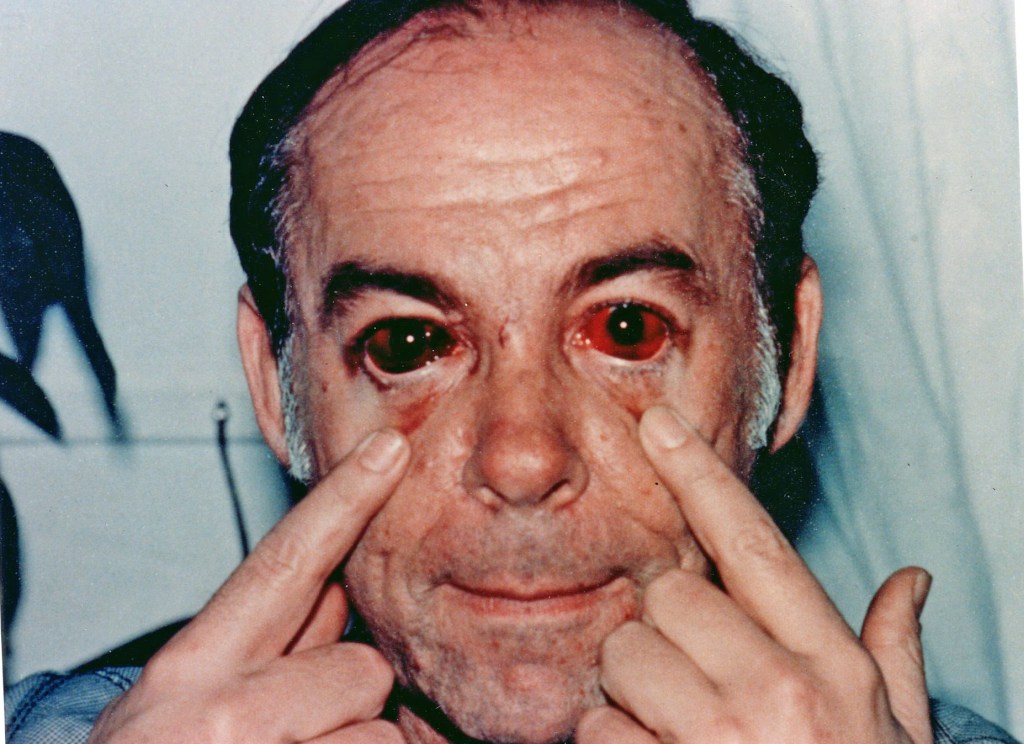
Flights 1 through 11 were completed without too much excitement. Unlike the A-7, the F-14 exhibited a docile post-departure mode and recovered easily after half a turn. All this changed on Flight 12 – my flight. The show didn’t stop – it was just beginning. The airplane started to develop a yaw rate and within a couple of turns the nose came up to a flat attitude. Within seconds the rotation rate shot up to 180deg/sec and g forces reached 7.8g eyeballs-out! My head was slammed against the instrument panel and my mask and eyes filled with blood! Twenty seconds had gone by and I lost consciousness.
There is much more to this story – obviously, since I am here to tell it. But take a look at the video which shows the complete spin. I have also attached a picture which shows what 7.8g does to a Naval Aviator.
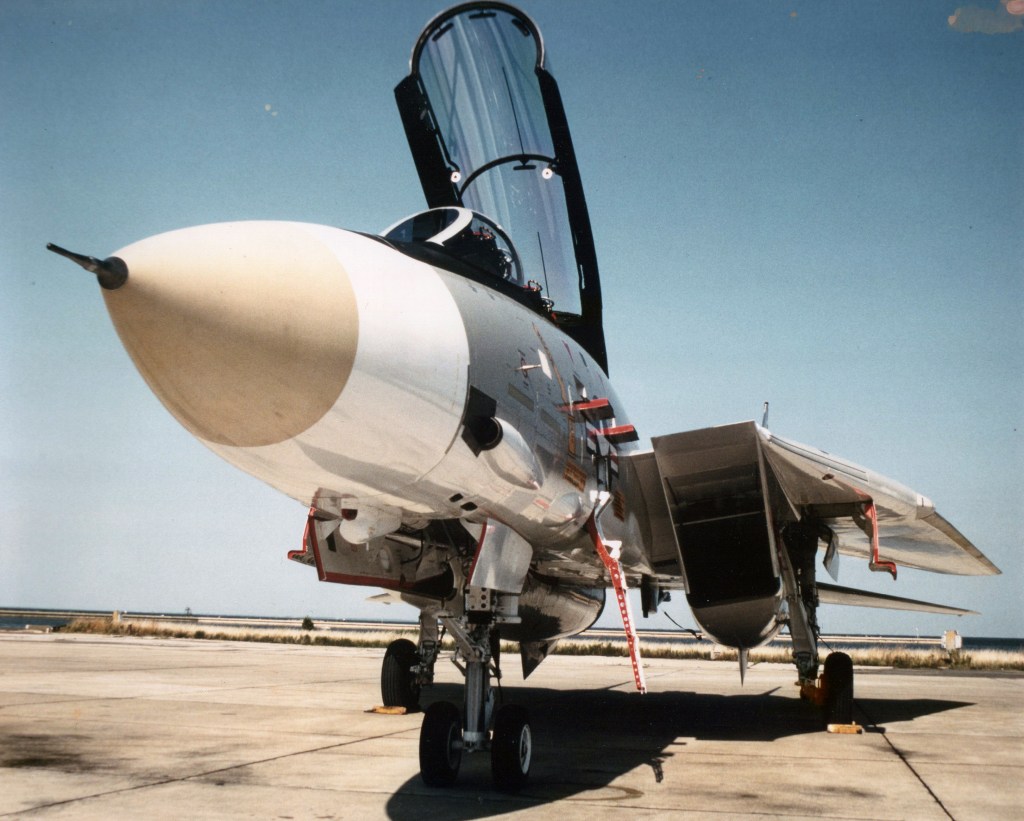
 Above Average
Ah, remember those days leading up to the bad news flat spin days and making the changes to the NATOPS Emergency Procedures to blow canopy and command eject if confirmed in a flat spin!! Tomcat Driver Smiles Bucchi
LikeLike
AOA = Angle Of Attack. It is the angle the wing enters the airflow. At high AOA the crew is at risk that the airflow collapses over the wing and the lift as well. If this drop is not equal on both wings then the A/C enters a spin.
LikeLike
Hi Marc — Well, you have part of it right on the money. The airplane must be in a stalled condition, whether it be from a 1g straight-ahead stall or an accelerated stall at 400 KIAS. Once stalled, the culprit becomes an excursion in yaw, usually caused by adverse yaw (yaw due to roll) or from asymmetric thrust (we lost an F-14 to this). The dynamics of spins can get really complicated: is the airplane “fuselage loaded” like a modern jet, or is it “wing loaded” like a WWII fighter? Will the rudder or stabilizer be blanked out in a spin? Once a spin is developed, the laws of inertia come into play. Picture a 2-ton dumb bell spinning through the air! Does the airplane have the control power to stop the rotation? Just what are the optimum recovery controls? What about asymmetric loads? Will the engine continue to run?
You get the idea — and thanks for your input. DD
LikeLike
You had to know Bob Smyth. I’m friends with his widow. She’s my neighbor.
LikeLike
Yes, I met Bob on several occasions.
LikeLike
DD, long time!! After you were my Boss at Strike, I continued with the spin program of the YA-7E even when your replacement asked me to NOT purposely spin the aircraft ….data based on your single seat work we had to be exactly the same asymmetric load to get a sustained fully developed spin…13000 ft pounds!! I was the next test on the spin range after your dramatic discovery with Pete Angelina! As I recall I think I helped Andy Burgess with the SAR effort. I remember your beautiful wife and car..Avanti!! I bet you still have both of them even today??
Thanks for your leadership back then…it was useful to me as I continued on “the hard way”.
Kent W. Ewing, Captain, USN, Retired (still flying the Eclipse 500 and my Baron)
kentewing@verizon.net
LikeLike