
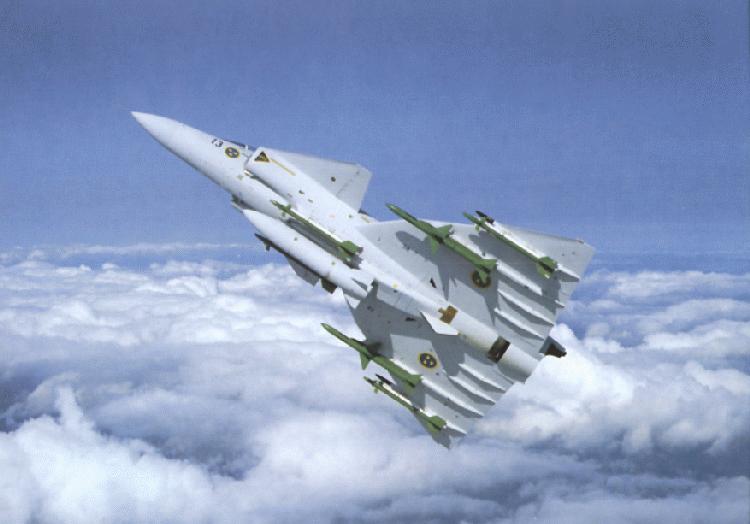
OK — it might be a bit of a stretch, but this airplane has two wings! It has a clipped delta main wing and a smaller wing located just aft of the cockpit. This forewing is much too large to be called a “canard” and it’s equipped with full-span flaps. It is aerodynamically brilliant, but so is the rest of this marvelous airplane.
The first question I get about the Swedish AJ37 Viggen (“Thunderbolt”) fighter is along the lines of, “What in the heck is the U.S. Navy doing testing a Swedish Air Force fighter?” It’s a reasonable question with a long answer. In a nut shell, the Eisenhower administration entered into an agreement with the Swedish government whereby the U.S. would exchange advanced aeronautical technology for Sweden’s development of a cutting-edge fighter to counter the Russian threat in the Baltic. The project was called “37-Annex,” and when prototype aircraft became available in 1970, the Naval Air Test Center was called upon to form a test team.
You can imagine my joy when I got the call! I was to be one of two test pilots on the team. George White was the other pilot, and two flight test engineers rounded out the test group. Life couldn’t be better!
The Viggen was awesome! The engine was a JT8D (widely used on Boeing airliners) equipped with a huge Swedish-designed afterburner. Dubbed the Volvo RM8, it was the second-largest engine ever to be installed in a fighter aircraft. It was more than 18-ft long and 4-ft in diameter. I used to say that a family of four could comfortably have lunch in the afterburner section! The Viggen was designed to operate out of Sweden’s highway system, so it had tandem main wheels, a thrust reverser, head-up display and a Navy-style angle-of-attack indicator to get that job done. With the reverser, it could execute a turnabout on a highway! I swear — hang a hook on this bird and it would be ready to land on a carrier!
Some tests were a bitch. Try pulling 9g at .9 Mach at 1000-ft and holding it for 10-sec so the cockpit recorder could pick it up. Do it ten times before you get it right! Other tests were more routine — handling characteristics, wind-up turns etc. We checked all the corners of the performance envelope, from stall to Vmax (which was 1.67 IMN, by the way). I was honored to be the 24th pilot to fly this airplane. Saab built 329 Viggens until the final bird was retired in 2005. It was replaced by the JAS-39 Grippen.
I’ve attached a couple of videos. The first shows me manning up for my first flight, assisted by Saab Chief Test Pilot Eric Dahlstrom. The second cut is my first take-off: max afterburner with the control stick full aft in my lap.
More on the Viggen next time …
 Above Average